
Redefining Retail Media: the Era of Agentic Commerce in 2026
You’ve spent the last ten years honing the craft of the thirty-second spot or the perfectly placed banner ad. Unfortunately, the industry has some unpleasant news for you: your new target audience doesn’t have eyes as we enter the era of Agentic Commerce in 2026.
By 2026, the primary “shopper” in the global economy will not be someone browsing a grid of product images, but a utility-based agent assessing your brand based on cold, hard metadata. Because of the rapid development of conversational AI, the advertising industry will experience a major structural disruption. We are shifting from an era of grabbing attention to one of outcome engineering in a machine-to-machine (M2M) marketplace. Welcome to the age of Agentic Commerce. In this world, the marketing funnel does not simply collapse—it disappears into the pipes of the internet.
The Plumbing of the Internet in Agentic Commerce in 2026
For those industry insiders who believed that Agentic AI was simply another generative chatbot, the reality of the situation is much more transactional. We are witnessing the emergence of a common “connective tissue” which enables AI agents to research, bargain, and complete transactions with or without human interaction.
At the heart of this is the Take a look. (Agentic Commerce Protocol)—a collaborative initiative between OpenAI and Stripe that provides ChatGPT a digital wallet. The ACP standardizes each phase of the transaction process, from payment tokenization to inventory validation. For example, if a consumer were to say “I want to order all I need for Taco Night,” the AI agent could then automatically complete the transaction. This is not a theoretical framework; it is the new standard for autonomous purchasing.
Discovery — The True War Zone
Anthropic launched Model Context Protocols (MCPs) in 2025 and it is rapidly becoming the de facto standard for how agents query an organization’s internal business systems. Other giants, like Openai and Stripe co-launched their Agentic Commerce Protocol (ACP) as well in 2025. The key here is that brands whose products cannot be accessed via an MCP servers are essentially invisible to the agents. According to industry leaders, brands must transition from creating User Experience (UX) solutions to developing solutions to protocol issues. Essentially this means when your “customer” is an AI agent instead of a human, the rules of engagement change from visual appeal to technical compatibility
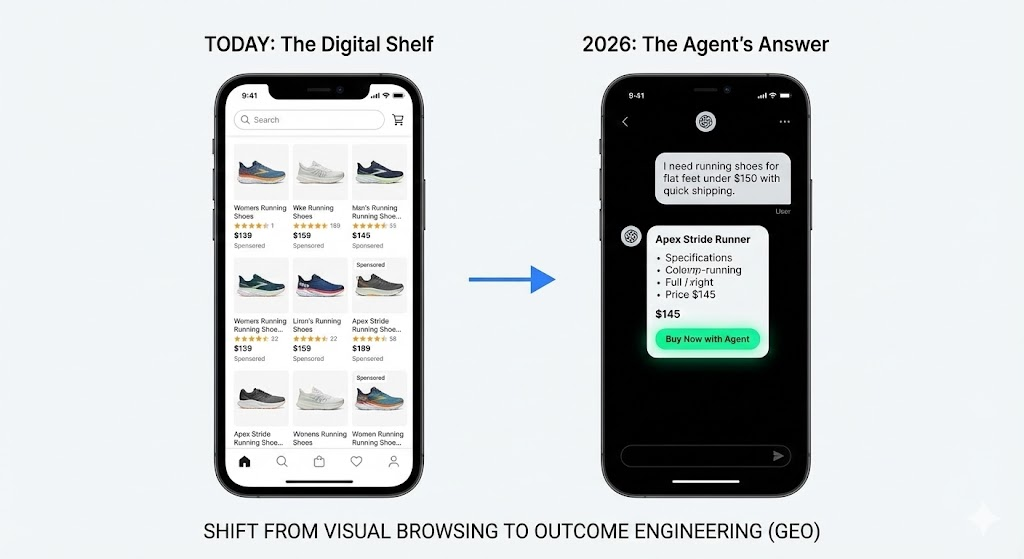
The Evolution of Retail Media Networks (RMNs)
Retail Media Networks (RMNs) have historically provided a haven for advertisers’ budgets. However, even RMNs are experiencing a transformation driven by necessity. The “Digital Shelf” is rapidly evolving from static product grids into conversational discovery interfaces.
Take a look. (Walmart Connect) has already shown us this transformation through its new advertising platform called Marty—a super agent for advertising. Marty allows organic product recommendations and paid advertising options to be optimized by the same neural re-ranking engine. Beta testing of Walmart’s Automated Creative Generator resulted in an 80% reduction in creative production time.
The Objective: Become the Default Recommendation
The objective is not merely to show an advertisement—it is to be the default recommendation in an AI’s response. If you do not receive the top recommendation, you are “optimized out” of the candidate pool prior to a human interacting with your brand name. This has given birth to a new field known as Take a look. (Generative Engine Optimization).
The Programmatic Ecosystem Becomes an Operating System
Take a look. (PubMatic) recently announced the launch of a system-level layer that enables agents to create, trade, and optimize campaigns in millisecond intervals. The statistics are compelling: early implementations have demonstrated that campaign creation has decreased by 87% and the speed at which campaign-related issues can be resolved has increased by 70%. These agents are able to perform multi-attribute optimizations across price, payment terms, delivery schedule, and service level simultaneously.
Agent-to-Agent Negotiation
When buyer bots negotiate price and terms with seller bots, the notion of a fixed rate card becomes a relic of the past. Traditional auctions that once took human buyers 30 minutes to resolve now resolve in mere seconds when executed by AI agents.
The Demise of Emotionally-Persuasive Advertising
Advertising has existed for over a century as a combination of emotion and storytelling. AI agents have neither emotions nor the capacity to tell stories; what AI agents have is utility functions. In an Agentic world, visual design matters less than refund policies and logistics guarantees. Research demonstrates that agents act as super-consumers evaluating products based upon the accuracy of structured metadata. An absent attribute on a product page may result in a 20-40% decrease in the likelihood of an agent selecting the product.
Creative is Now a Data Problem
New tools enable large-scale systematic analysis of creative assets—converting subjective pixels into a quantifiable dataset. We are now at the beginning of the Take a look. (Age of Creative Intelligence), as an Agent could discover that using a rounded font is related to a 5% higher conversion rate amongst specific audiences.
Conflict of Interest and the Trust Crisis
A major conflict of interest has emerged as the Discovery Layer moves up-stream to platforms like ChatGPT. In order to offset its impending deficit, Take a look. (OpenAI plans to feature sponsored content) in chat responses. By 2026, OpenAI expects to generate approximately $1 billion in ad revenue. This has created a trust crisis: Will an AI provide the best medical advice regarding headache relief or the best paying advertiser? Analysis of sentiment toward the concept of advertising generated from AI shows that 68% of all users express negative sentiment toward the concept of AI-generated ads.
Who Emerges Victorious and Who Fades Away?
There will be an absolute transfer of power by 2026. The victors will be the platform gatekeepers—Amazon, Walmart, Google, and OpenAI—controlling the protocols where discovery terminates and transactions begin. Brands that regard their product data as the new form of targeting will succeed. Losers include mid-tier retail chains with significant technological debt, and creative agencies unwilling to evolve from emotion-focused workflows.
The Agentic Commerce 2026 Accountability Checklist
For the CMO today, the path forward to success is no longer about developing better ads—it is about developing a better architecture.
- First, your data must be machine readable. This includes implementing Take a look. (Structured Entity Graphs), and anchoring your brand to a stable @id so that agents can access and utilize your brand data.
- Second, you must develop an agent-initiated payment solution. Tools such as Take a look. (Stripe will allow you to generate virtual cards) for programmatic checkout.
- Third, you must develop new KPIs. Click-through rate is a legacy metric; your new boardroom standards should include metrics such as agent usage to determine whether the AI is providing truthful information about your brand.
The largest threat in 2026 is not the technology itself—it is the failure to recognize that the storefront is now an algorithm. If the machine does not approve of you, the human will also disapprove.