The Structural Hedge: Why Physical Inventory is the New Digital Safe Harbor
There is a seismic shift occurring within the digital advertising ecosystem due to changes in the generation and valuation of supply-side inventory. With the disappearance of third-party cookies and the emergence of privacy regulations like GDPR and CCPA which prohibit traditional browser tracking, media buyers are shifting their attention toward programmatic audio and digital out-of-home (DOOH). While these may appear to be secondary channels, they serve as a technical safe harbor for inventory generation. That is, platforms generate inventory from the physical environment users occupy, not from individual user identifiers. The shift represents a fundamental diversification of the media supply base. It moves the allocation of programmatic budget from the contested browser environment into the screen-free moments of consumers’ daily lives.
Industrializing the “Physical Pixel” Using OpenRTB 2.6
Previously, “hacked” implementations of display and video protocols limited audio and DOOH trading, causing substantial data loss and diminished yields. The industry has reached a maturity level with the implementation of OpenRTB 2.6 by the IAB Tech Lab. It established the first viable industrial floor for the physical assets in question.
Solving the “Podding Crisis” Through Logic, Not Luck
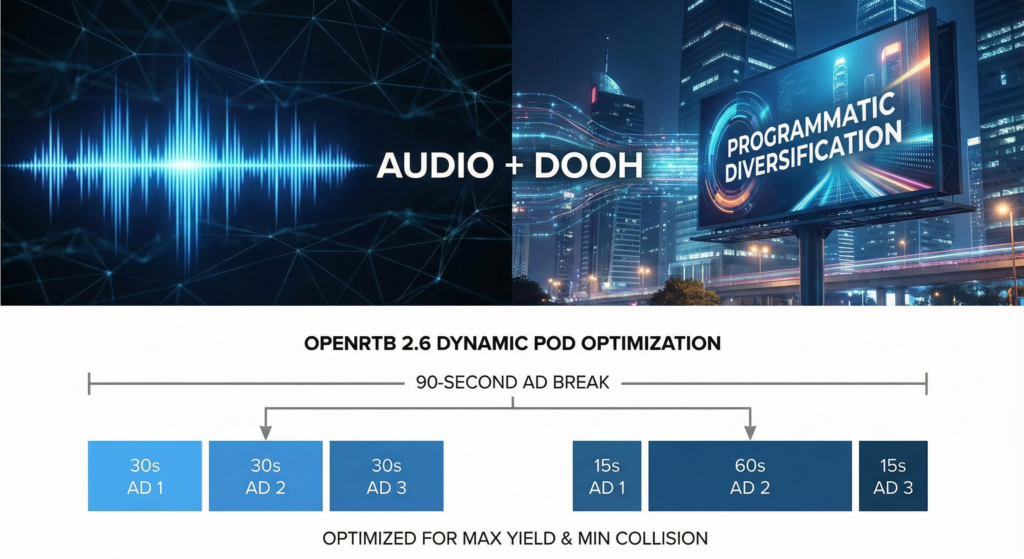
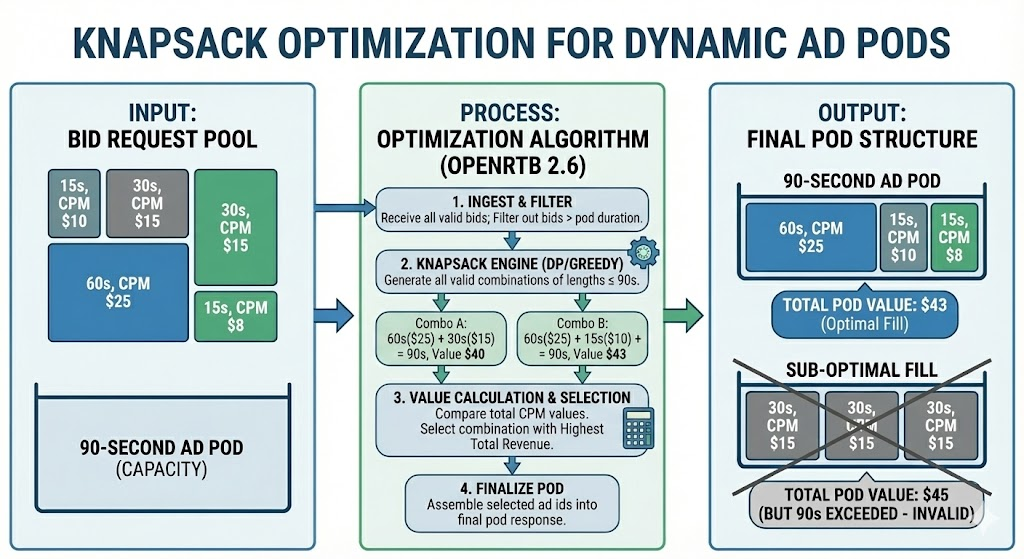
Prior to this development, buyers had to submit sequential commercial breaks, or ad pods, as separate, disconnected bid requests for each slot. This mechanical friction could lead to competitive collisions where the listener would hear two consecutive ads for the same brand. OpenRTB 2.6 introduced dynamic pods. Dynamic pods allow publishers to establish a total duration (for example, 90 seconds) instead of establishing a predetermined number of slots. Under this model, the supply-side platform (SSP) will run a knapsack optimization algorithm to determine the optimal combination of bids (15s, 30s, 60s etc.) that maximize total revenue. Therefore, podcast monetization will be able to reflect real-time market demand for the first time.
The DOOH Object: Mapping the Real World to the Bid Stream
The new IAB Tech Lab standards eliminated the cumbersome workarounds and added a dedicated DOOH object to the bid stream that captures the physical characteristics of the screen. This allows for programmatic inclusion/exclusion based upon venue types such as:
- Airports
- Gyms
- Transit shelters
Importantly, the protocol now also has a standardized field for the impression multiplier. The impression multiplier communicates how many individuals are viewing one screen play. The OpenRTB 2.6 protocol brings the signals for the real-world inventory into core protocol objects to reduce the time required for demand-side platforms (DSPs) to ingest real-world inventory.
Reality Checking the Metrics: Many-to-One Measurement
The primary challenge in this transition is the shift from the “one-to-one” deterministic model of the web to a “many-to-one” physical model. In DOOH, the impression multiplier is the numerical factor used to bill for multiple viewers per screen play. Since there is no universally accepted method of calculation, the methodologies used to calculate the multipliers vary:
- Computer vision sensors: These use “Likelihood to See” (LTS) to measure the accuracy of viewership based on head orientation and dwell time.
- Mobile geofencing: This method estimates the density of devices in a screen’s geofence using aggregated SDK data.
- Past traffic patterns: Some networks rely on legacy traffic surveys which fail to capture real-time fluctuations.
Buyers, therefore, frequently perform third-party verification audits on SSP multipliers to avoid the possibility of over-inflated CPMs.
Verification of audio consumption also faces a “gap”. While streaming audio provides complete and robust completion data, the podcast space relies upon server-side ad insertion (SSAI). According to the IAB Podcast Measurement Guidelines, a “download” requires at least 60 seconds of audio to be transmitted, but this does not confirm that the user heard the ad or skipped it. Therefore, many sophisticated buyers are shifting to outcome-based measurements, such as physical sales lift, versus solely relying on delivery metrics.
The Convergence of Context and Performance
Programmatic audio and DOOH are inherently “privacy-first” since they are activated by the environment, not by continuous user tracking. The evolution of contextual targeting in audio now utilizes natural language processing (NLP) to analyze podcast transcripts for sentiment and safety in real-time. This permits brands to associate ads to the listener’s mood or activity. Research indicates that matching ads to a listener’s state—such as a “Workout” playlist—significantly increases the emotional impact of the ads.
Similarly, in the physical world, DOOH utilizes environmental triggers, such as weather-based logic, to activate bids. For instance, Aperol Spritz restricted bids to periods when the temperature was above 19°C (66°F). The emphasis on performance is increasing with the emergence of in-store retail media which links programmatic screens and audio to closed-loop attribution via retailer loyalty data. This convergence is anticipated to represent 55.9% of all DOOH growth by 2029.
Winning the Omnichannel Decade
It is evident that there is a diversification trend occurring:
- Nestlé: The brand experienced a 58% increase in incremental reach by including programmatic audio in their mix.
- Mercedes-Benz: The automaker successfully utilized real-time bid optimization to generate in-store traffic at dealerships.
However, adoption remains hampered by the siloed nature of media agencies and the lack of expertise between the traditional out-of-home teams and the programmatic trading desks within agencies. Agencies are increasingly employing SPO (Supply Path Optimization) initiatives to eliminate intermediaries and ensure price transparency.
By mastering the technical subtleties of OpenRTB 2.6 and verifying the multipliers that govern these emerging spaces, buyers will finally be able to target the “eyes-free mind” and the “moving body” with the same precision that has heretofore been reserved for the browser.